
Why Are My eBay Sales Down? 10 Possible Reasons My Sales Dropped 40% in October

My eBay sales are down 40% this month.
Forty per cent.
And there were still a few days of October left.
I'm not going to pretend that hasn't annoyed me, because it absolutely has.
And the bit that's really got under my skin?
I've been doing what I thought I was supposed to do.
I've been adding more listings and building my shop. Normally, when I list more, I sell more.
That's been the pattern since I started eBay reselling.
But this month? Nope.
So rather than sit here complaining about it, I did a bit of digging into why my eBay sales are down, and came up with ten possible reasons, plus what I'm going to do about it.

A quick note before we start
Everything here is based on my own experiences, opinions and research as a small UK eBay seller.
I've looked at publicly available reports, company announcements and what's been happening in the reselling community. But the reasons below are possible explanations, not proven causes of my falling sales.
I'm not affiliated with eBay, and I'm certainly not claiming to know exactly how its algorithms work. I'm just a beginner trying to understand what's happening to my business.
And judging by the comments I've been getting and the videos I've been watching, I'm not the only one having a difficult October.
Is eBay Dying? Not According to the Evidence
If you're new here, hiya! I'm Arroe, and I'm trying to build a consistent income through eBay reselling from my little cottage in the Scottish countryside.
I also live with severe OCD and agoraphobia, which makes running a business a bit more complicated.
I sell mostly preloved clothing. My shop is called Arroe Finds, and I'm still very much a beginner.
Which is why I share the good months, the bad months, and apparently the months where eBay decides to test my patience.
The question I wanted to answer wasn't whether eBay is dying.
Because I don't think that's what the evidence shows.
The question was: why might small UK clothing sellers like us be finding things so difficult right now?
I looked at what's happening in UK retail, what eBay has been doing this year, changes to advertising, the second-hand clothing market, and what's happening inside my own shop.
Some of these things we can do absolutely nothing about.
Others? There might be something we can try.
1. The Weather
I know. We're British. Blaming the weather is practically a national pastime.
But this one actually has some evidence behind it.
The British Retail Consortium and KPMG released their September retail figures, and clothing had fallen from fourth place in August to tenth place in September in their ranking of retail categories.
Tenth!
And one of the explanations was the unusually warm weather.
People simply weren't rushing out to buy their autumn and winter wardrobes.
If you're still wandering around in a T-shirt in September, you're probably not thinking about buying a big woolly jumper.
These figures are for the wider retail market, not specifically second-hand clothing on eBay. But I think they tell us something useful about what shoppers were prioritising.
And if people delayed buying their winter wardrobes in September, it's possible some of that delayed demand has carried into October.
The good news is that it's getting colder now.
And up here in Scotland, I can assure you, winter has absolutely no intention of being subtle.
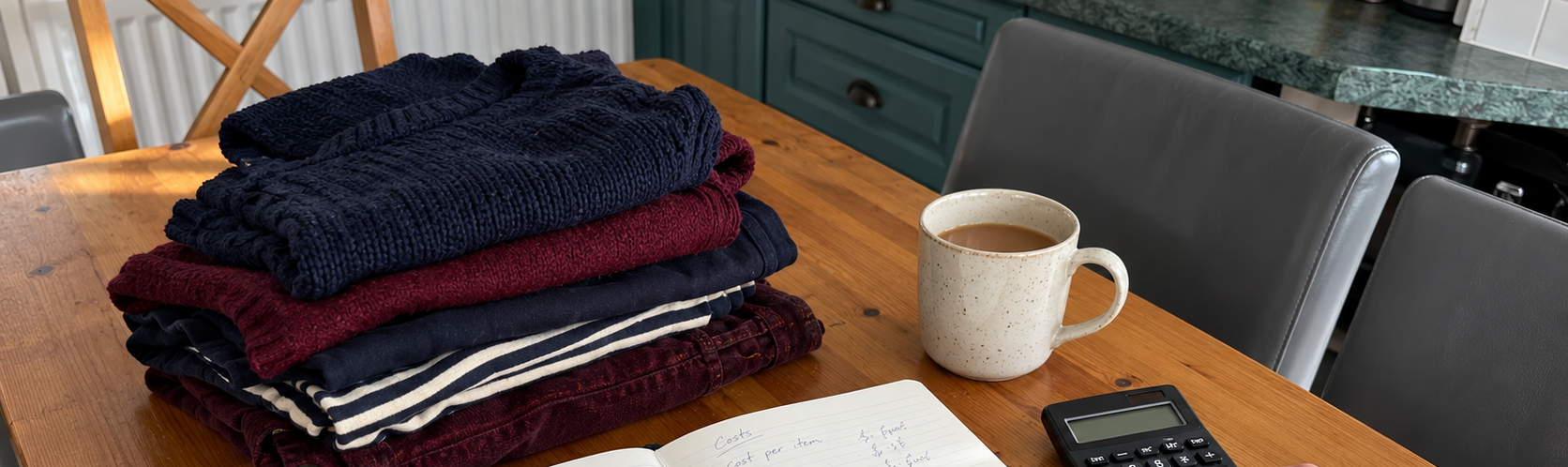
2. People Are Watching Their Money
This one is probably the most important.
The Confederation of British Industry (CBI) reported that online retail sales volumes fell in September at the fastest rate in nearly three years.
Nearly three years.
That's not just eBay. That's the wider online retail sector having a difficult time.
With households thinking about heating bills, food prices and the upcoming Budget, it's understandable that some people are more cautious about spending.
I don't think this means people have stopped buying second-hand clothing.
If anything, second-hand can offer brilliant value when money is tight.
But there's a difference between needing a winter coat and fancying another blouse.
I wonder whether people are becoming much more selective. They're looking for something they actually need, or something that's such a good deal they don't want to miss it.
So for me, this is a reminder to look at value.
Not necessarily to slash every price in my shop, but to make sure my prices, photographs and descriptions give buyers a reason to choose my item.
3. Black Friday Is Coming
KPMG suggested that with Black Friday approaching, some shoppers might be putting off purchases because they're wondering whether they'll get a better deal later.
And I think we've all done that.
You see something you quite fancy, but you know the sales are coming, so you think, I'll just wait.
I can't prove that people are doing that with £15 second-hand blouses on eBay.
But it wouldn't surprise me if some of that behaviour carries over into resale.
If October's slowdown is partly people delaying purchases, we might see some of that demand return in November.
I'm also considering a Black Friday promotion in my own shop.
But I won't be discounting things just for the sake of it.
There's no point making ten sales if you've given away all your profit to get them.
4. eBay Live Is Changing How People Shop
This one is more of a theory.
eBay has been investing in live shopping, where sellers can demonstrate and sell items during a live broadcast.
Traditionally, most of my buyers find something by searching for it. They want a particular brand, size or item.
Live shopping is a completely different experience. People can browse, chat, discover things they weren't looking for and buy during a show.
It's a bit like combining shopping with entertainment.
So could some shoppers be spending more time discovering items through Live rather than ordinary listings?
I genuinely don't know.
I haven't found any evidence that eBay Live is responsible for slower sales in regular shops. It's equally possible that Live is bringing extra buyers and spending onto the platform.
But it's another way of selling, and I've already been planning to try it, so I'm going to test it rather than speculate.
Which could be brilliant.
Or it could be me talking to three people and a clothing rail for an hour.
Either way, we'll find out.
5. Competition From Private Sellers
This one is particularly relevant to UK clothing sellers.
eBay removed selling fees for UK private sellers across most categories in 2024, with certain exceptions.
That changed the economics of selling unwanted clothes.
If you're simply clearing out your wardrobe, you can potentially sell an item without paying the same selling fees a business seller has to account for.
I'm not suggesting private sellers shouldn't have that benefit.
But it does mean we're operating with different costs.
I have stock to buy, business fees, packaging, postage and other overheads to think about.
Someone clearing out their wardrobe might be perfectly happy accepting £8 for a jumper that I need to sell for £15.
And that's completely understandable.
I haven't found evidence that private sellers have specifically caused my October decline. But the different selling costs are worth understanding.
For me, the answer isn't to try to be the cheapest seller on eBay.
It's to offer a good service, clear photographs, accurate descriptions, reliable delivery and items people actually want.
6. eBay Bought Depop
This one really caught my attention.
In July, eBay completed its acquisition of Depop for approximately $1.4 billion in cash, including adjustments.
If you're not familiar with Depop, it's a second-hand fashion marketplace that's particularly popular with younger shoppers.
eBay already has a huge fashion resale business, so why buy another fashion marketplace?
According to eBay's own announcement, Depop gives it access to a highly engaged community of younger fashion buyers and sellers.
I think that tells us how important second-hand fashion is to eBay's future.
But I want to be careful here.
I'm not saying Depop has taken buyers away from my shop. I don't have any evidence of that. And because eBay now owns Depop, success on that platform could actually be good for the wider business.
What I am saying is that the second-hand clothing market is changing.
Different generations are shopping in different ways, on different platforms, and discovering clothes through different types of content.
It also makes me wonder whether, eventually, I should sell on more than one platform.
Relying entirely on one marketplace does make you vulnerable when sales slow down.
7. Promoted Listings and Paying for Visibility
Right. Promoted listings.
I suspect we're all going to have opinions about this one!
I wanted to look at the actual numbers rather than just assume eBay is making us pay more to be seen.
In its second-quarter results, eBay reported that its first-party advertising revenue had grown by 25% compared with the same quarter the previous year.
That's a significant increase, and it shows just how important advertising has become to eBay's business.
That doesn't prove ordinary listings are being deliberately hidden.
But it does raise a fair question about how much advertising small sellers need to use to compete.
eBay offers different types of advertising, including General campaigns and Priority campaigns, and the costs and placement opportunities aren't the same.
For smaller sellers like me, the important question is whether the extra visibility produces enough profitable sales to justify the cost.
Getting more people to see your listing isn't the same as getting more people to buy it.
I've been experimenting with my advertising settings, including dynamic rates, to see whether I can improve visibility. But I'm also watching my margins.
Because if I'm paying more to advertise an item and it still doesn't sell, I'm not really solving anything.
So rather than assuming a higher ad rate is the answer, I'm going to look at impressions, clicks, sales and actual profit.

8. There's a Lot of Second-Hand Clothing Out There
This one is difficult to measure precisely, but I think it's worth discussing.
Second-hand fashion has become increasingly mainstream.
More people are comfortable buying preloved clothes, which is fantastic. But more people are also interested in selling them.
And when you're selling fairly common brands, that can mean a lot of competition.
Take something like a Next jumper. There might be multiple sellers offering similar styles, sizes and colours, and the buyer can compare condition, price, delivery and photographs before deciding.
I haven't got figures proving there are more Next jumpers listed today than a year ago.
But I can see from my own sourcing and listing that everyday clothing is a very competitive market.
If I add another fifty ordinary blouses, am I creating fifty new sales opportunities?
Or am I adding more items that are all competing for the same sort of buyer?
That's one of the reasons I'm trying to introduce a wider range of stock.
Not abandoning everyday clothing.
Just trying not to put all my eggs in one very crowded basket.
9. eBay Is Growing, But That Doesn't Mean Every Seller Is
This is probably the most surprising part of my research.
If you only listened to sellers having a difficult month, you might think eBay itself was struggling.
But the company's financial figures tell a different story.
In its second-quarter results for 2026, eBay reported gross merchandise volume of approximately $22.4 billion, up 15% on the same quarter the previous year.
That's the total value of goods sold through its marketplace during that period, before certain adjustments.
So eBay, as a whole, was growing.
But that's a global figure, across all sorts of products, markets and sellers.
It doesn't mean UK preloved clothing sellers are seeing the same growth, and it doesn't mean every individual business is doing well.
Some sellers might be having their best month ever while others are barely making sales.
That's why I think we need to be careful when people say either that eBay is dying or that eBay is booming. Both are far too broad to tell us what's happening in our own little corner of the marketplace.
eBay can be growing as a company while my shop has a terrible October.
Both things can be true.
10. It Might Actually Be My Own Shop
And finally, the one I probably don't want to admit.
Some of this might be me.
It's easy to look at the weather, the economy, advertising and competition. I also need to look at what I'm doing.
I've added a lot of listings since I started, and for a while, more listings meant more sales.
But now I'm wondering whether I've reached the point where I need to focus less on the number of listings and more on the quality and performance of the stock.
1,000 listings that nobody wants aren't necessarily better than 500 listings people are actively searching for.
I've got quite a lot of everyday clothing, and some of it has been sitting there for over thirty days.
That doesn't automatically make it stale, and I'm not claiming eBay stops showing items after a month. But older stock is worth reviewing.
Are my prices still competitive?
Are my photographs good enough?
Are my titles using the right keywords?
Is the item actually something people want at this time of year?
The three numbers I'm checking
Impressions: are my listings being shown to buyers?
Click-through rate: when people see my listings, are they interested enough to click?
Conversion: when people visit my listings, are they buying?
Those figures won't tell me everything, but they should help me work out where the problem might be.
If impressions are falling, I need to investigate visibility.
If people are seeing my listings but not clicking, I need to look at photographs, titles, prices and how competitive the items are.
And if they're clicking but not buying, I need to look at the offer itself: price, condition, delivery and whether the item is desirable.
That's a much better starting point than throwing more stock at the problem and hoping for the best.
What I'm Going to Do About It
There's no point spending hours investigating something if I don't try to improve it.
1. A seven-day experiment
For seven days, I'm aiming to list ten new items every day and refresh or relist ten older items each day.
That's 140 listing actions across the week.
It's not a perfect scientific experiment. I'm changing more than one thing, so I won't necessarily know which change made the difference.
But I should be able to see whether my overall sales, impressions and conversion improve compared with the previous seven days.
2. Reviewing older stock
I've added a relisting tool to my setup, and I'm going to use it for items that have been sitting for thirty days or more.
But I'm not going to relist everything blindly. I want to check prices, photographs and titles too.
Relisting something nobody wants at the same price probably isn't going to work miracles.
I'm also going to test accepting offers on those older items.
3. Diversifying my stock
I've already started moving beyond everyday preloved womenswear.
I'm introducing more menswear, new-with-tags clothing, accessories and miscellaneous items, some of it from the mystery unboxings on my YouTube channel, which have been great fun to film.
4. Trying eBay Live
I've been talking about doing it for a while, and I think it's time to stop talking and actually have a go.
I want to test whether live selling works for my stock, my audience and the way I run my business.
5. Not panicking
Which, admittedly, is easier said than done when you're staring at your sales dashboard wondering where everybody's gone.
But I've only been doing this for a few months. I haven't got years of sales history to compare against.
One difficult month doesn't mean the business is failing.
It means I need to learn, adapt and keep an eye on what's happening.

We Can't Control Everything
So that's ten things that might be contributing to slower eBay sales this October.
Some backed by wider retail figures.
Some based on changes happening in the marketplace.
And some that are simply my own theories from running a small clothing business.
We can't control the weather, the economy or what eBay decides to do next.
But we can control what we list, how we price it, how we present it and how we respond when things aren't working.
Where these figures come from
CBI: September 2026 retail conditions
KPMG: September 2026 Retail Sales Monitor
British Retail Consortium: Retail Sales Monitor
eBay: Second Quarter 2026 Financial Results
eBay: Depop acquisition announcement
Ten possible reasons.
Five things to try.
And one seven-day experiment to see what actually works.
A Little Note About My Images ♡
You'll notice that the images across my blog are a mixture of my own photography and AI-generated images.
I'm a one-woman band running this little corner of the internet, without a team of photographers, designers or editors behind me. Living with OCD also means I can be particularly careful about things like copyright and image permissions, so I sometimes use AI to help bring my ideas to life without those additional worries.
Where possible, I love sharing my own photographs, especially glimpses of my cottage, garden and everyday life here in Scotland. Other times, I'll use AI-generated imagery to illustrate an idea or provide a little creative inspiration.
I believe in being transparent, so I wanted you to know that you'll find a mixture of both throughout my website. The words, experiences, opinions and ideas are my own.
Thank you for supporting my little one-woman blog! ❤️


Comments