
100 Sales on eBay: What I’ve Learned as a Beginner Ebay Reseller

Updated: Oct 26
I’ve officially hit my first 100 sales on eBay.
Actually, by the time I sat down to film the video this post is based on, it was 103.
So we overshot slightly.
My total turnover at that point was £1,507.01, with a profit margin sitting at roughly 45%. That includes the fact that I offer free delivery, so postage is coming out of that too.
Am I suddenly an eBay expert?
Absolutely not.

I won’t be one after 1,000 sales either.
But considering I started this with a fairly basic I'll buy some clothes, put them on eBay and see what happens business plan, I’m genuinely really happy with where it’s going.
And 100 sales feels like a decent point to stop and look at what I’ve actually learned.
Because there are definitely things I wish I’d realised sooner.
Where the eBay shop is now
Before the lessons, a quick update on the slightly ridiculous target I’ve set myself.
I’m trying to reach 1,000 active listings by 15 September.
At the moment I’m adding somewhere around 25–30 new listings a day.
Which is a lot.
It’s also the reason I can’t give you a particularly useful sell-through rate yet. My shop is changing too quickly. Something sells, but then I add another 25 things, so the total inventory is constantly moving.
Once I reach 1,000, I want to stop adding stock at this pace.
The plan is to keep the shop roughly around 1,000 listings for 30 days, probably adding just three or four items a day to keep it moving, and actually watch what happens.
How many things sell?
What’s my real sell-through rate?
What turnover does 1,000 listings generate?
Which brands move?
What’s the actual profit?
That month will tell me much more than trying to calculate everything while I’m throwing new clothes onto eBay every day.
Then, if I’m happy with what 1,000 listings produces, the next ridiculous target will probably be 2,000.
Knowing me, anyway.
But first: the things I’ve learned from the first 100 sales.
1. List the stock you already have
This is probably the biggest one.
Stock sitting in a box is not really stock.
It’s money sitting in a box.
Nobody can buy it.
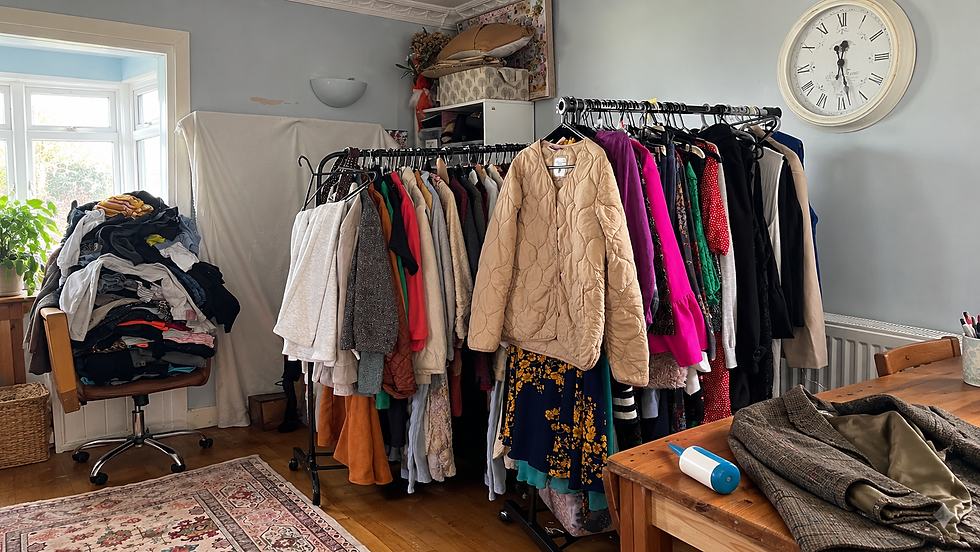
I completely understand now why resellers end up with piles of unlisted clothes around the house because I currently have exactly that.
My dining room can confirm it.
But buying another wholesale box because buying stock is more exciting than listing the box you already have isn't particularly helpful.
One of my goals before reaching 1,000 listings is to get almost every piece of stock I own online.
Then I can actually say:
This is what I own.
This is what I paid.
This is what it’s listed for.
This is how much inventory value I have.
And these are the sales that stock is generating.
If you’ve spent £1,000 on inventory but half of it is sitting on the floor waiting to be photographed, your numbers don't tell you very much.
Someone can't buy it if they can't see it.
2. The obvious items aren't always the best ones
When I started thinking about clothing reselling, I thought about the obvious stuff.
Dresses.
Tops.
Jeans.
Trousers.
Coats.
And obviously I sell all of those.
But some of the little things I probably wouldn't have deliberately sourced have surprised me.
Hats.
Ties.
Accessories.
Things that arrive mixed into wholesale boxes and initially make me think:
Fine. I'll stick it on.
One tie cost me roughly 47p.
It sold for £37.
That certainly improved my opinion of ties.
It taught me not to dismiss something simply because it isn't what I'd normally go looking for.
If something is cheap, in really nice condition and there appears to be a market for it, I'll give it a go.
I'm not going to start buying everything I see.
But I'm definitely more open-minded than I was when I started.
3. I actually like having a niche
My shop is mainly women’s clothing, and right now I’m happy with that.
If an accessory or something slightly different comes in with my stock, I'll list it.
But I don't particularly want to build an enormous shop containing one lamp, seven dresses, a PlayStation game, two mugs and somebody's old lawnmower.
There's nothing wrong with that model.
It just isn't what I want.
I like the idea that somebody can buy a dress from me, come back a few weeks later and find another hundred pieces of women's clothing they haven't seen before.
The bigger the shop gets, the more important that becomes to me.
If I eventually reach 2,000 or 3,000 listings, I want the shop to make some sort of sense when you land on it.
Maybe one day I'd create a separate men's shop or children's shop.
But for now, women's clothing gives me enough to learn without trying to sell the entire contents of Britain.
4. More listings have meant more sales for me
I know resellers have different opinions on this, and remember: this is based on my first 100-ish sales.
I'm not declaring an eBay law.
But so far, every time my active listings have grown, my sales have grown too.
Not instantly.
I don't upload 100 things and immediately get ten extra sales.
It doesn't work like that.
But generally, as the shop gets bigger, my sales have become more consistent.
Which does make logical sense.
If the stock is good, properly priced and photographed well, having 1,000 listings simply gives you more opportunities to have something a buyer wants than having 100.
Obviously, 1,000 terrible items don't magically become a good business.
The stock still matters.
But inventory size is something I’m now taking very seriously.
And I am very curious to see what happens when those 1,000 listings sit there for a full month.
5. I don't care if a brand isn't exciting
Spend enough time watching reseller content and you'll hear the same brands.
Boden.
Monsoon.
Seasalt.
White Stuff.
Linen everything.
And I like those brands too.
If I can buy them cheaply, brilliant.
But some of the items I keep selling are not remotely exciting reseller finds.
F&F jeans, for example.
I don't know what it is about them.
Maybe people really like the fit.
Whatever it is, I struggle to keep them in stock.
I've sold Primark.
I've sold supermarket brands.
I've sold things another reseller might look at, see the label and immediately put back.
I'm increasingly interested in the actual item.
Is it in good condition?
Is it a useful size?
Is the style wearable?
Can I price it competitively?
How cheaply can I buy it?
If I pay 50p for something and make £4 or £5 profit fairly quickly, I am completely fine with that.
I don't want every item in my shop making £4 forever.
But bread-and-butter stock absolutely has a place.
6. I’m liking a 70/30 stock mix
At the moment, I'm roughly thinking about the shop as:
70% bread-and-butter stock
and
30% more premium stock.
That isn't some magic formula.
It may completely change as I get more data.
But I like what it does.
The everyday stock gives me regular £10, £12, £15 and £18 sales.
Then the more premium pieces give me the bigger individual profits that pull the average up.
I don't particularly want a shop containing nothing but expensive stock that takes three months to sell.
I also don't want 1,000 items flying out while I make £2 every time I pack a parcel.
I'm looking for the middle.
Regular sales.
Reasonable margins.
Occasional big wins.
Right now, 70/30 feels quite comfortable.
7. My next target is £10 profit per item
My current average profit per item is roughly £6.50–£7.
At this stage, I'm happy with it.
I used to run a candle business where I made around £5 profit on a candle, so I certainly can't complain about making £7 on a piece of clothing.
But eventually, I want that average closer to £10 per item.
Because once you're selling in volume, that extra £3 becomes enormous.
Sell 100 items at £7 profit:
£700.
Sell exactly the same 100 items at £10 profit:
£1,000.

Same number of parcels.
Same general workload.
£300 difference.
So I'm experimenting with adding a few higher-margin pieces.
I've started buying small amounts of new-with-tags stock, normally when something is heavily reduced.
Not dozens of pieces.
Three or four.
Then I'll see what happens before buying more.
I'm also particularly interested in larger sizes, where certain styles can become difficult to find once retailers start selling out.
Maybe the idea will work beautifully.
Maybe in six months I'll discover it was completely pointless.
That's the fun bit.
8. Stop panicking about slow days
This one is mostly aimed at myself.
When you're new, every day feels incredibly important.
You have three good sales days.
Then suddenly...
Nothing.
And your immediate thought is:
That's it. eBay has switched me off.
An established reseller who's been doing this for five years probably looks at one quiet Tuesday and barely notices.
They've got years of data.
They know what August normally looks like.
They know their busy periods.
They know a slow day doesn't mean their entire business has collapsed.
I don't have that history yet.
So I'm trying to stop judging the shop on individual days.
My job right now is pretty boring:
Buy decent stock cheaply.
Check the condition.
Take decent photographs.
Measure it.
Write the listing properly.
Price it sensibly.
Give good customer service.
Keep going.
That's basically it.
9. Comparing yourself with established resellers is pointless
I currently have five followers on my eBay shop.
Five.
We're absolutely flying.
And I'm genuinely grateful for them.
A couple seem to look at my new listings fairly regularly, which made me realise how powerful that could become over time.
Imagine having 300 followers.
Or 1,000.
Or 3,000.
Every time you list something, you've potentially got people who already know your shop checking what's new.
That's something an established reseller has spent years building.
They also have years of feedback.
Years of knowledge about what sells for them.
Maybe several selling platforms.
Thousands of active listings.
I currently sell only on eBay.
I've had 103 sales.
So comparing my Tuesday with somebody who has been doing this for 12 years and wondering why they've sold 25 things while I've sold three is completely useless.
The better comparison is:
Where was I a month ago?
That's the one that actually tells me something.
10. You have to actually like doing it
This might be the biggest lesson of all.
I see loads of reseller content from people saying they absolutely hate listing.
And fair enough.
Every business has annoying bits.
But listing isn't a tiny side job in reselling.
It's most of the business.
Photographing.
Checking clothes.
Measurements.
Listings.
Storage.
Finding sold items.
Packing.
Posting.
Then doing it all again.

If you hate nearly every part of that process, I'm not entirely sure why you'd deliberately build yourself a business requiring you to do it hundreds of times every month.
At the moment, I genuinely enjoy it.
Opening a wholesale box is obviously my favourite bit.
It gives me the same buzz I imagine people get from finding something incredible in a charity shop.
But I like photographing the clothes.
I like making the listings.
I like seeing the active listing number go up.
I like getting the sales.
I even like finding the item and packing the parcel.
There genuinely isn't one major part of the process at the moment that makes me think:
God, I hate this.
That's probably a large part of why I've managed to list at the speed I have.
I want it to make money, obviously.
But I don't feel like I'm dragging myself through something I hate purely because there's money at the other end.
So if you're thinking about becoming an eBay reseller because you've watched somebody online making a full-time income from it, I wouldn't spend thousands on stock tomorrow.
Buy ten things.
Maybe twenty.
Photograph them.
List them.
Store them.
Wait for them to sell.
Find them again.
Pack them.
Post them.
Then ask yourself:
Would I be happy doing this hundreds of times every month?
If the answer is yes, you might have found something worth building.
Where I'm at after 100 eBay sales
So this is my very beginner eBay business after my first 100 sales:
£1,507.01 turnover
Roughly 45% profit margin, including free delivery
Around £6.50–£7 average profit per item
And I'm currently charging towards 1,000 active listings.
Once I get there, that's when I think the really interesting experiment starts.
Hold the shop around 1,000 listings.
Track it for 30 days.
See what it actually produces.
Then decide whether pushing towards 2,000 listings makes sense.
I'm also planning to try live selling, which I may either absolutely love or spend the entire thing wondering why I thought it was a good idea.
We'll find out.
The main thing I've realised after these first 100 sales is that I'm not particularly interested in copying somebody else's eBay business.
I want to work out what my eBay business looks like.
And 100 sales in, I feel like I'm only just starting to find out.
A Little Note About the Numbers ♡
Everything here is my own experience, with my own stock, time and circumstances, so your results may be very different and I can't promise you'll make a similar amount, or any money at all. Fees, prices and platform rules change often, so please check the current details with eBay yourself. This isn't financial, tax or legal advice. If you're earning money from selling, check the current rules on gov.uk to see whether you need to tell HMRC, or speak to an accountant.
A Little Note About My Images ♡
You'll notice that the images across my blog are a mixture of my own photography and AI-generated images.
I'm a one-woman band running this little corner of the internet, without a team of photographers, designers or editors behind me. Living with OCD also means I can be particularly careful about things like copyright and image permissions, so I sometimes use AI to help bring my ideas to life without those additional worries.
Where possible, I love sharing my own photographs, especially glimpses of my cottage, garden and everyday life here in Scotland. Other times, I'll use AI-generated imagery to illustrate an idea or provide a little creative inspiration.
I believe in being transparent, so I wanted you to know that you'll find a mixture of both throughout my website. The words, experiences, opinions and ideas are my own.
Thank you for supporting my little one-woman blog! ❤️


Comments