
What It Costs to Get Our 180-Year-Old Cottage Ready for Winter

Updated: Oct 26
Living in a 180-year-old cottage in Scotland is lovely in summer.
Then August starts disappearing, the nights get darker and you suddenly look around the property thinking:
Right. What is going to fall off when the first proper winter storm arrives?
We have quite a lot to do.

None of it is particularly glamorous. There will be no beautifully styled baskets of logs in this post.
We're talking boilers, chimneys, pipes, roofing sheets, timber and trying to stop the workshop roof disappearing before it takes my electrics with it.
And that's before I even think about where all my eBay reselling stock is going to live over winter.
So I've started making a proper list.
Based on current UK prices, I think we're realistically looking at somewhere around £600–£1,400 to get through the jobs below if we can do a decent amount ourselves and nothing horrible turns up.
Which, in a 180-year-old house, is admittedly quite an optimistic final sentence.
1. Properly fixing the greenhouse roof
This one has already had the classic old-house treatment:
temporary fix first, deal with it properly later.
Part of the greenhouse roof needed fixing, and we've managed to make it secure for now.
But before winter it needs doing properly.
That means replacing some of the wood underneath so we've actually got something solid to screw the roofing into, then fixing everything down securely enough that Scottish winter weather doesn't undo all our work.
And we need another drill.
Our current setup isn't really up to the amount of building and repairing we're doing now, so a decent new drill has officially moved from nice to have to we actually need this.
Basic cordless drill kits are currently around £50 at the cheaper end, while more substantial branded models can easily be £100–£130 or more.
Timber isn't individually horrendous — treated 2.4m lengths can currently start at around £5–£10 depending on size — but once you start buying multiple lengths, screws, fixings and all the other little bits, it adds up remarkably quickly.
Rough budget: £90–£210
Assuming we do the work ourselves.
2. Getting the boiler checked
This is one of those things I absolutely do not want to discover has a problem in January.
The boiler needs its annual check before we're properly into winter.
We've lived through enough rural-house chaos to know that heating is one of the things you deal with before you desperately need it.
Current UK pricing puts a standard boiler service at roughly £80–£120, with around £100 being typical for a gas boiler. Oil boiler servicing is in a similar range.
Obviously, that's assuming the service ends with:
"Everything looks fine."
Not:
"Come and look at this."
Rough budget: £80–£120
Hopefully.
3. Having the chimneys swept and checked
Then there are the chimneys.
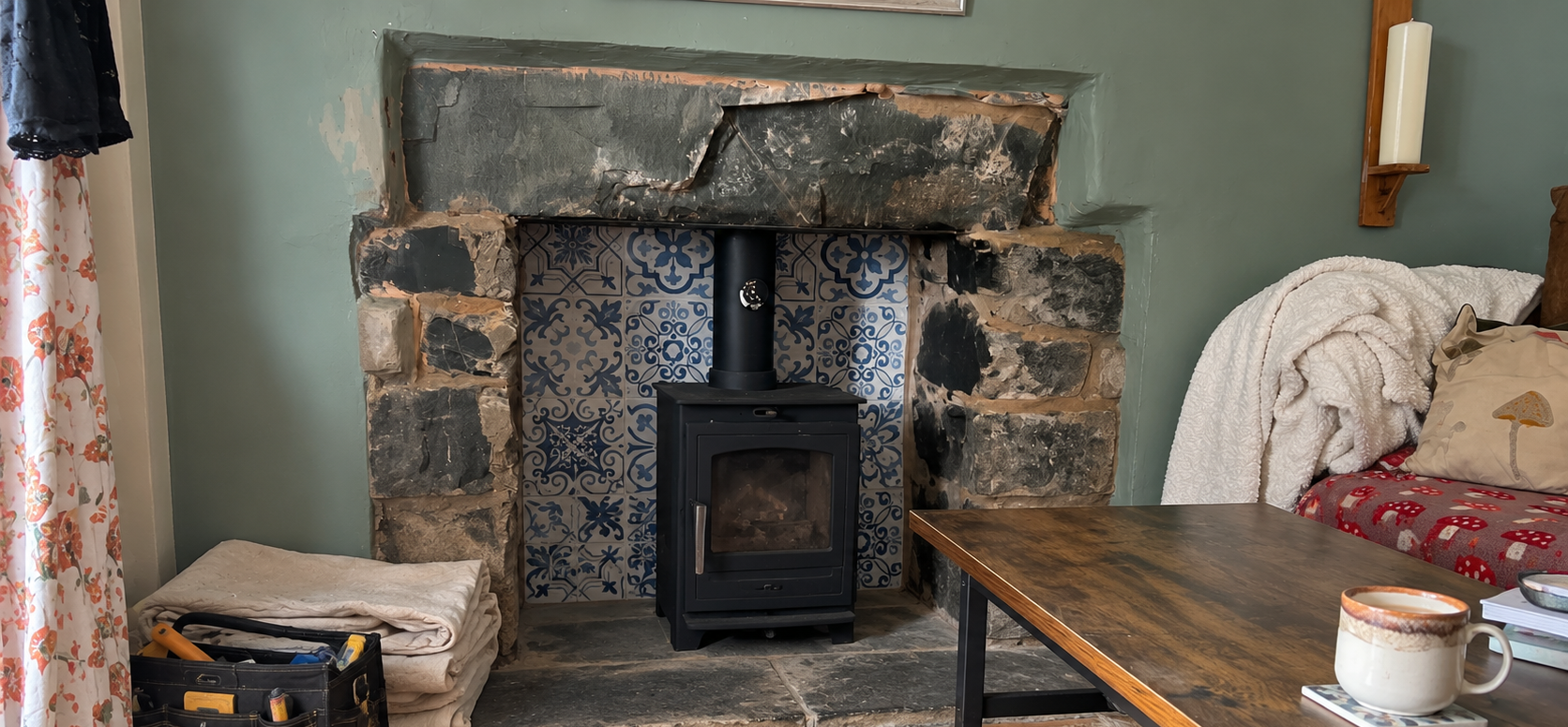
Because apparently owning an old cottage means spending a surprising amount of your adult life thinking about chimneys.
Before we start properly using fires again, I want them swept and checked.
This isn't something I particularly want to gamble with.
Current UK figures put an ordinary chimney sweep at around £70–£110 for many standard chimneys, although older, unlined or more complicated chimneys can cost more. Two chimneys can come in around £130–£310 depending on their condition and when they were last cleaned.
And ours belong to a house that's been standing here for roughly 180 years.
So I don't automatically assume anything involving them will be straightforward.
Rough budget: £130–£310

4. More outside lighting before the dark nights arrive
This one sounds less important until you actually live somewhere properly rural.
There is very little outside lighting here.
In summer that's lovely.
In winter you open the door at five o'clock and you're basically staring into the void.
It is pitch black.
We need more lighting around the outside of the cottage, particularly around the areas we're actually walking through regularly.
I don't want to turn the place into an airport runway. One of the nicest things about living somewhere this dark is actually seeing the night sky.
But I would also quite like to reach the bins without breaking my neck.
Basic outdoor LED lights can start at around £20–£25 each at the moment.
Exactly what this costs us will depend on whether we use solar/rechargeable lighting in some areas or install more permanent wired lights.
Rough budget: £50–£120
Potentially more if we decide we need an electrician.
5. Fixing the water pipe at the front of the cottage
This one is boring.
Unfortunately, boring house jobs have an irritating habit of becoming expensive house jobs if you ignore them.
There's a section of water pipe at the front of the house that needs repairing.
And I'd much rather deal with a slightly problematic pipe now than a completely problematic pipe when everything outside is freezing.
The cost here is difficult to predict because it depends enormously on access and exactly what needs replacing.
Current UK guides put relatively straightforward leak repairs at around £77–£128, while more involved water-supply pipe repairs can run into several hundred pounds.
I'm hoping ours is firmly in the first category.
Rough budget: £100–£330
Please behave, pipe.
6. Building more growing beds for winter vegetables
This is the one job on the list that I'm actually excited about.
I want to build more outdoor beds so we can get more coastal winter vegetables growing.
We've got this strange little microclimate near the sea, and I really want to experiment with how much food we can keep producing through the colder months.
But more beds mean...
You guessed it.
More wood.
A lot more wood.
Timber doesn't look particularly expensive when you're looking at one £7 length.
Then you realise you need twelve of them.
And screws.
And supports.
And probably something else you forgot.
I'm trying to build these simply rather than buying expensive ready-made raised beds, because that makes far more sense for the amount of growing space I eventually want.
Rough budget: £80–£200
This could easily grow as the garden grows.
Which feels strangely appropriate.
7. Fixing the workshop roof before the storms get to it
This is probably the job I'm most nervous about leaving too long.
Part of the curved roofing on the workshop needs replacing and fixing properly before the winter storms arrive.
Because underneath that roof are electrics.
And electricity plus rain is not one of the charming quirks of cottage living I'm particularly interested in experiencing.
Corrugated roofing sheets themselves aren't hugely expensive. Current retail prices are roughly £20–£40 per sheet for many common PVC or bitumen options, plus the proper fixings.
The bigger issue is getting the right piece, getting it secured properly and making sure the surrounding roof is still sound.
Again, we're hoping to do as much as possible ourselves.
Rough budget: £40–£100
Assuming it genuinely is just the section we already know about.
So what could all of this cost?
My rough working budget currently looks something like this:
Greenhouse roof, timber and new drill: £90–£210
Boiler service: £80–£120
Chimneys: £130–£310
Outside lighting: £50–£120
Water pipe repair: £100–£330
New vegetable beds: £80–£200
Workshop roof: £40–£100
So we're somewhere in the region of:
£570–£1,390
And I think mentally I'm just calling that:
£600–£1,400 to get ready for winter.
That is before anything unexpected is found.
Before we decide another bit of wood is rotten.
Before somebody looks at a chimney and makes a concerned noise.
Before the boiler suddenly develops opinions.
And before we've spent anything sorting out additional storage for the growing amount of eBay stock currently making its way into this house.

Old houses don't really have a finished state
I think that's one of the things I've realised since living here.
You don't finish an old cottage.
You get one part working.
Then you notice another part.
You fix the greenhouse roof and remember the workshop roof.
You sort the workshop and notice the pipe.
You build some vegetable beds and suddenly decide you need six more.
There is always something.
But I don't actually hate that.
This house has been standing here for around 180 years because generations of people have repaired things, replaced things, patched things up and occasionally probably stood outside swearing at a roof.
Now it's our turn.
And getting it ready for winter isn't really about making everything perfect.
I just want the boiler working, the chimneys safe, the roofs attached to the buildings they're supposed to be attached to, enough light to see where we're walking and preferably no water pouring out of anything that shouldn't have water pouring out of it.
The bar is surprisingly reasonable.
Ask me again after the first Scottish storm.
A Little Note About Costs and Advice ♡
These costs are what we have been quoted or expect for our own 180-year-old cottage in rural Scotland, and they are rough guides only. Prices vary by area, tradesperson, season and the condition of your property, so please get your own quotes. I'm not a builder, surveyor or financial adviser, and this isn't professional or financial advice. Gas, electrical, chimney and roofing work should always be done or checked by a suitably qualified professional (for gas appliances, that means a Gas Safe registered engineer).
A Little Note About My Images ♡
You'll notice that the images across my blog are a mixture of my own photography and AI-generated images.
I'm a one-woman band running this little corner of the internet, without a team of photographers, designers or editors behind me. Living with OCD also means I can be particularly careful about things like copyright and image permissions, so I sometimes use AI to help bring my ideas to life without those additional worries.
Where possible, I love sharing my own photographs, especially glimpses of my cottage, garden and everyday life here in Scotland. Other times, I'll use AI-generated imagery to illustrate an idea or provide a little creative inspiration.
I believe in being transparent, so I wanted you to know that you'll find a mixture of both throughout my website. The words, experiences, opinions and ideas are my own.
Thank you for supporting my little one-woman blog! ❤️


Comments