
Reading Journal Ideas: How to Start a Book Journal for 2027

A new year.
A new stack of books by the bed.
And that little voice saying, this year I'll actually remember what I read.
Because how many times have you finished a lovely book, and a month later couldn't tell anyone what happened in it?
That's where a reading journal comes in.
It's just a notebook for your books.
So here are some simple reading journal ideas to help you start one for 2027.
What Is a Reading Journal?
A reading journal (sometimes called a book journal) is a notebook where you keep track of what you read.
That can be as simple as a list of titles.
Or it can be a page for every book, with a rating, your favourite quotes and how it made you feel.
There's no right way to do it.
It's yours, so it only has to make sense to you.
They've become rather popular on Pinterest, and it's easy to see why.
Pinterest's own 2026 Hobbies Trend Report showed searches for "book log journal" up 482%, as part of a wider return to handmade journals, zines and scrapbooks.
People want something they can hold.
Something that isn't another app.
Why Keep One?
A few reasons it's worth the bother:
You'll actually remember what you read. Writing even two lines about a book helps it stick
You'll read more. Seeing a page fill up is motivating
It's a record of your year. Flicking back through it the following December is a lovely thing to do
It's slow and screen-free. Ten minutes with a pen and a cup of tea is a nice way to end the day
It costs very little. A notebook and a pen is all you need to begin
Paper or an App?
Plenty of people use an app like StoryGraph or Goodreads to count their books, and that's absolutely fine.
A paper reading journal is different.
It's slower.
And that's the point.
You sit with the book a little longer, you think about what you actually felt, and you end up with something you can pick up and flick through years later.
You could always do both.
The app for the numbers, the notebook for the good bits.

What You Need to Start
You probably have most of this already.
A notebook. Any notebook. A5 is a good size because it sits flat on a lap or a bedside table
A pen you like writing with. This matters more than you'd think
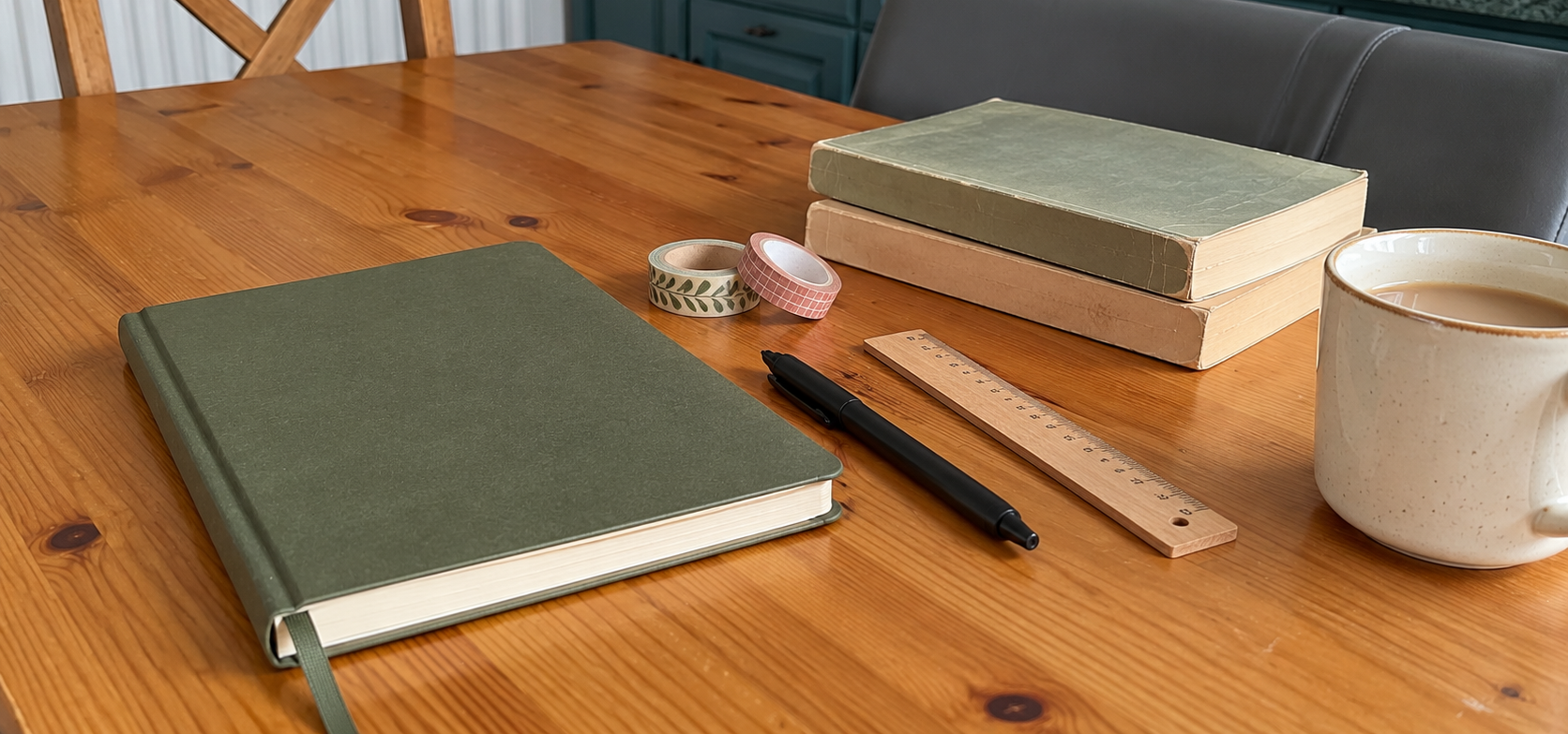
A few optional extras. Washi tape, a ruler, one or two coloured pens and a glue stick for tickets or bookmarks
What it costs
You can spend almost nothing, or quite a lot.
Paperchase A5 casebound notebooks at Tesco: about £6
LEUCHTTURM1917 A5 Medium dotted notebook at John Lewis: £22.90, with numbered pages and an index at the front, which is very handy for a reading journal
Algebra Mix Washi Tape Set from Fred Aldous: £12 for five rolls
Honestly, an old notebook from the back of a drawer works just as well.
It's always worth a look in the charity shop too, because unused notebooks and diaries turn up a lot.
Dotted pages are the easiest for layouts. Lined is great for writing, and plain gives you the most freedom.
How to Set Up a Reading Journal
Step 1: Pick your notebook and number the pages
If your notebook doesn't have page numbers, add them now.
It takes about 10 minutes and saves a lot of flicking later.
Step 2: Make an index
Leave the first two pages blank and write "Index" at the top.
Every time you add a new page, write its page number and what's on it here.
Future you will be very grateful.
Step 3: Set up a few yearly pages
These go at the front and cover the whole year.
A to-be-read list, a books-read log and a monthly tracker are plenty to begin with.
You can always add more later.
Step 4: Add a page for each book as you finish it
Not before.
Only make the page once you've actually read the book. Otherwise you end up with half-empty pages and a bit of guilt.
Step 5: Leave some space at the back
Keep the last few pages free for quotes, lists and whatever else you think of later.
There's always something.
Simple Reading Journal Ideas to Try
You don't need all of these.
Pick two or three that sound fun and start there.
A books-read log
One line per book: the date you finished it, the title, the author and a star rating.
This is the one page everyone should have, and if you only ever do this, that's still a reading journal.
A to-be-read list
The books you want to get to this year.
Tick them off as you go, and don't feel bad about crossing off any you've gone off the idea of.
A bookshelf tracker
Draw a row of empty shelves and colour in a book spine every time you finish something.
Use a different colour for each month, or for each kind of book.
It's very satisfying to fill in.
Single book review pages
Title, author, when you read it, a rating and a few lines on what you thought.
If you get stuck, try a few simple prompts:
Who was your favourite character?
What line stayed with you?
How did it make you feel?
A favourite quotes page
Copy out the lines that stop you in your tracks.
Writing them out by hand makes you slow down and read them properly again.
Monthly wrap-ups
At the end of each month, list what you read and pick a favourite.

How to Keep Your Reading Journal Going
It's very easy to start a reading journal in January and forget all about it by February.
These are the little things that help yours last the whole year.
Keep it next to whatever you're reading.
Write little and often.
Don't compare it to Pinterest.
Skip what you don't enjoy.
Pick it back up without guilt.
None of this has to be done in January.
A reading journal can start on any page, on any day of the year.
And a year of books you'll actually remember.
A Little Note About My Images ♡
You'll notice that the images across my blog are a mixture of my own photography and AI-generated images.
I'm a one-woman band running this little corner of the internet, without a team of photographers, designers or editors behind me. Living with OCD also means I can be particularly careful about things like copyright and image permissions, so I sometimes use AI to help bring my ideas to life without those additional worries.
Where possible, I love sharing my own photographs, especially glimpses of my cottage, garden and everyday life here in Scotland. Other times, I'll use AI-generated imagery to illustrate an idea or provide a little creative inspiration.
I believe in being transparent, so I wanted you to know that you'll find a mixture of both throughout my website. The words, experiences, opinions and ideas are my own.
Thank you for supporting my little one-woman blog! ❤️


Comments