
How to Create the Ultimate Summer Night Spa Routine at Home

Updated: Aug 12
Hot days are great right up until about 8pm, when you realise you're still sweating, your skin feels like it's been wrapped in cling film, and winding down feels almost impossible.
That's the problem with British summers, when we actually get a warm one, nobody's quite prepared for it. Central heating houses, thick duvets, and skin that's used to cold wind suddenly have to cope with 28 degrees and 80% humidity.
A proper evening routine that addresses the heat specifically makes a real difference, not just to how your skin feels, but to how quickly you actually switch off and get to sleep.
Research from the University of Texas at Austin found that a warm bath taken one to two hours before bed causes the body to push heat from its core out to the skin's surface, and when you step into a cooler room afterwards, your core temperature drops faster than it otherwise would, which is one of the physical signals your brain needs to initiate sleep. This routine uses that principle and builds on it.
It takes roughly 45 minutes to an hour. You don't need a huge collection of products. Here's how to do it properly.

Step 1: Start with a cool-down shower and body scrub
Don't go straight into a bath. Start with a lukewarm shower, not cold, not hot, and use the time to scrub. Summer skin collects a lot: sun cream, sweat, pollution if you're in a city.
A good body scrub used once or twice a week clears all of that away so your skin can actually absorb what you put on it afterwards.
Work the scrub into damp skin in circular movements, starting at your feet and moving upward. Focus on your shins, the backs of your arms, and your shoulders, all the spots that tend to dry out and go rough. Rinse off with slightly cool water at the end. It brings your skin temperature down before you step out.
One thing worth debunking here: people assume you need to scrub hard for it to work. You don't. Firm, consistent pressure in small circles is more effective than scrubbing like you're cleaning a pan, and you won't end up with red, irritated skin afterwards.

It's 94% natural origin ingredients, smells genuinely lovely (Indian rose and almond), and the combination of Punjabi pink salt and sweet almond oil does actually leave skin nourished rather than stripped, which is exactly what you want before a bath.
Step 2: Run a warm (not hot) bath with bath salts
This is where a lot of people go wrong in summer. They skip the bath entirely because it sounds too warm, or they run it scalding hot out of habit. A warm bath, ideally around 38 to 40°C, actually helps cool you down over the following hour. Your blood vessels dilate, your body pushes heat to the surface, and when you get out into a cooler room, your temperature drops faster than it would have otherwise.
Pour your bath salts in as the water runs, not after. They need time to dissolve properly. Two or three good handfuls is about right. Soak for 20 minutes. You can read, put something on your phone, or just lie there, all valid options.
Epsom salts are a popular choice here because the warm soak itself helps relax muscle tension, and the salt formula tends to carry calming botanicals well. Whether the magnesium in Epsom salts absorbs meaningfully through skin is debated among researchers, so it's best to think of the soak itself as the main event rather than any particular mineral claim.
For a summer night routine specifically, look for a formula with calming botanicals infused with Frankincense & Bergamot, known for their calming and soothing properties.

Enriched with CBD oil and infused with Frankincense and Bergamot. The uplifting scent and CBD oil helps to promote relaxation and reduce stress, leaving you feeling rejuvenated and refreshed.
Step 3: Apply a cooling sheet mask in the bath
This is the step most people skip, and it's the one that makes the biggest difference to how your face feels.
While you're soaking, put a sheet mask on. Pop it in the fridge for 15 minutes before you get in the bath, even that short amount of time makes it noticeably cooler against your skin.
Sheet masks work by creating a physical seal over your skin that slows the active ingredients from evaporating off. Dermatologists describe this as the occlusive effect, the serum absorbs properly rather than just sitting on the surface.
In summer, that means hyaluronic acid and aloe vera can actually get into the skin rather than drying off in the warm air. Leave it on for 15 minutes while you soak, then peel it off and pat the remaining serum into your neck.
Don't rinse your face afterwards. That serum is the point.
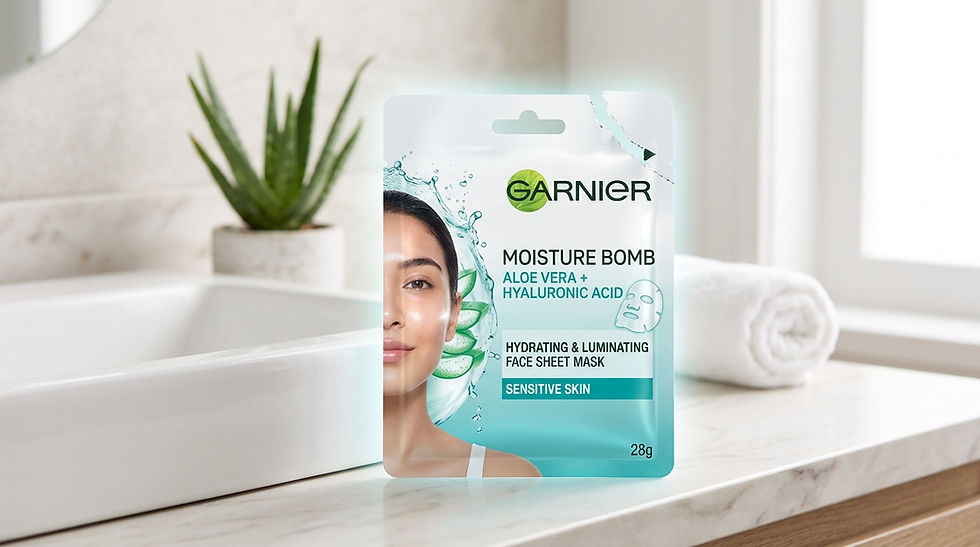
Aloe vera has a well-established cooling and soothing effect on skin, and pairing it with hyaluronic acid in a sheet mask format means you're getting hydration and a calming hit at the same time, and it costs less than £2 per mask when bought in a multipack.
Step 4: Use a jade roller after the mask
Get out of the bath, pat yourself dry, and while your face is still slightly damp and the serum is still tacky, use your jade roller. Keep it in the fridge, not the freezer, overnight. A night in the fridge is enough to make it genuinely cool to the touch without it getting so cold it causes discomfort.
Roll outward and upward. Start at the neck, work up to the jaw, then across the cheeks toward the temples, and finish across the forehead. Use the small end around the eye area. You're not pressing hard, you're just moving fluid that tends to pool when you've been horizontal or in the heat. It takes about three to four minutes and visibly reduces puffiness, particularly around the eyes and jaw.
The idea that jade rollers need to be made from "authentic jade" to work is a bit of a myth. What matters is that the stone is cool and smooth. Both of those are true of most decent rollers regardless of the exact mineral.

It's one of the most consistently reviewed jade roller sets on Amazon UK, comes with a gua sha stone for extra facial massage work if you want it, and the stone stays genuinely cool for long enough to be useful after a bath.
Step 5: Finish with a lightweight body oil
The last step is the one that ties everything together. After you've dried off, apply a body oil to still-slightly-damp skin. The dampness matters, oil applied to dry skin sits on top; oil applied to damp skin helps lock in the moisture that's already there.
In summer, skip anything that feels thick or waxy. You want an oil that absorbs within a couple of minutes and doesn't leave you feeling like you've greased a baking tin. Pay attention to the texture when you're choosing: oils with a light, non-comedogenic base, jojoba and sunflower are both good bets, absorb the fastest.
Apply it to your legs, arms, shoulders, and anywhere that tends to feel dry by morning. You'll sleep without your skin feeling tight, and you won't wake up needing to immediately reach for a moisturiser.

It absorbs quickly without leaving a greasy residue, which is the main thing you need from a body oil in summer, and the vitamin A and E blend means it's doing something useful for skin texture over time, not just sitting on the surface overnight
A note on order and timing
The sequence matters more than any individual product. Scrub first so your skin's clean, bath next to relax and start bringing your temperature down, mask during the bath so it's doing its work while you soak, roller straight after to deal with puffiness, oil last to seal everything in.
If you skip straight to the oil without the bath, you lose the temperature-drop benefit. If you do the roller before the mask serum has had a chance to absorb, you're just rolling it off again.
Give yourself the full 45 minutes at least twice a week through summer. On the nights in between, even just the bath salts and the oil takes 25 minutes and you'll still notice the difference in how you sleep.
Disclosure: This post contains affiliate links. As an Amazon Associate, I earn from qualifying purchases. Some product images in this post are AI-generated illustrations due to copyright restrictions on third-party imagery.


Comments