
7 Wreath Autumn Ideas (And What Actually Makes Them Look Good)

There's a version of an autumn wreath that looks incredible and costs roughly the price of a decent bunch of flowers. There's also a version that costs you an entire Saturday, a bag of craft supplies, and your sanity. The difference usually comes down to knowing which direction you're heading in before you start.
This post covers seven wreath ideas that are worth your time this autumn. Some are for making and some are for buying smart, and one of them involves doing almost nothing and still ending up with something that looks considered and intentional.

1. Dried pampas and seed head wreath
Dried wreaths have been popular for a few years now, and they've stuck around because they actually hold up well. A base of dried pampas grass, honesty seed heads (those flat, translucent disc-shaped ones), and a few dried poppy heads gives you something that looks well put together without being fussy.
The key with dried materials is to keep the colour palette tight. Creams, pale browns, and dusty pinks work well together. If you start adding dried orange slices and red berries and dark foliage all to the same wreath, it starts looking like a craft project rather than a decoration. Pick two or three materials and stick to them.
One thing most tutorials skip over: dried wreaths shed. A lot, at first. Give yours a shake outside before you hang it and you'll avoid finding seed heads on your doorstep for a week.

2. Foraged foliage on a grapevine base
If you're anywhere near a park, a woodland, or even a decent hedgerow in September or October, you've got most of what you need. Beech branches with their papery brown leaves, rosehip stems, and sprigs of dried bracken can all go onto a grapevine or wire ring.
Grapevine bases are worth buying rather than making yourself. You can get them for around £3 to £6 online or from craft shops, and they give you a structure that's easy to tuck stems into without needing wire or a glue gun. Foraged materials won't last more than a couple of weeks without some wilting, so this is a wreath to make fresh rather than weeks in advance.
Don't overthink the arrangement. Tuck stems in at the same angle all the way round and it'll look coherent. That's genuinely all there is to it.

3. Preserved eucalyptus and bay
This is the low-effort option, and I don't mean that as a criticism. A ring of preserved eucalyptus (the kind florists use, which you can buy in bunches) and a few stems of fresh bay hung on a plain hessian ribbon looks clean and smells good. It'll last months without drooping.
The received wisdom is that preserved foliage looks fake. That's not really true of eucalyptus. It tends to take on a muted grey-green colour that suits autumn better than you'd expect. Bay keeps its colour for a good few weeks before it starts to dry out, and even then it holds its shape well.
If you want to add something to break up the green, pressed fern fronds work well. They're free if you've got any in the garden, and they press flat enough to tuck easily into the back of a foliage ring.

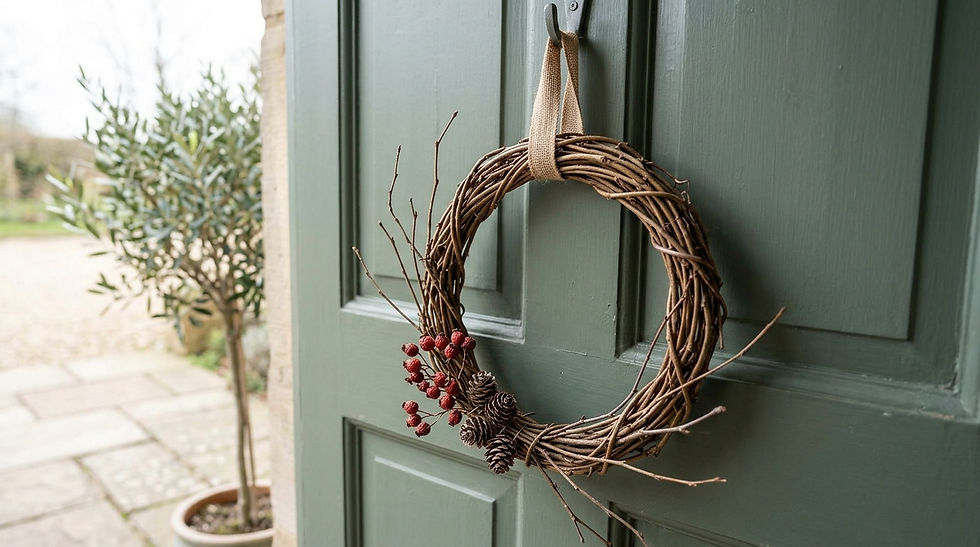
4. A simple twig wreath with minimal additions
You can buy twig wreaths bare for very little, and there's an argument for keeping them that way. A wreath made from twisted birch or willow twigs with nothing added to it except a ribbon for hanging looks far better on certain doors than an overloaded one would.
If you want to add something, one material is usually enough. A handful of dried berries wired in at one point on the ring, or a cluster of small pine cones hot-glued at the base, gives you a focal point without turning it into a display cabinet.
This is also the most practical option if your front door is covered. Dried materials and foliage can go mouldy quickly in damp, sheltered spots. A twig wreath handles those conditions far better.
5. Faux pumpkin and berry wreath
For anyone who wants something that'll last from September through to the end of October without replacing it, a wreath with good-quality faux pumpkins and berry clusters is worth considering. The quality varies a lot. The ones that look convincing tend to be the ones with slightly imperfect shapes rather than perfectly round, uniform versions.
Wire or glue small faux pumpkins (look for ones around 5cm to 8cm) at intervals around a moss-covered ring, fill in the gaps with berry sprigs, and you've got something that reads autumnal without being specifically Halloween.
The honest caveat: cheap faux pumpkins are immediately obvious and pull the whole thing down. It's worth spending a bit more on two or three that look right than buying a bag of ten that don't.

6. All-leaf wreath in a single colour family
This one involves more materials than some of the others but it's probably the easiest in terms of assembly. Use only leaves, all in the same colour family, and cover the base completely. Copper, rust, and amber leaves pressed together with no gaps look really effective, and the uniform approach is more forgiving of slightly wonky arrangement than a mixed-material wreath.
Skeleton leaves (the kind where only the leaf veins remain) are worth including if you can find them. They add texture without adding more colour. You can buy them in packs of around 30 to 50 and they're inexpensive.
The key is making sure the leaves overlap in the same direction all the way round. If some are facing left and some right, it looks messy. Same direction, overlapping by about a third each time.

7. Dried citrus and cinnamon stick wreath
This is the one that makes a difference the moment you open the front door. Dried orange slices (about half a centimetre thick, dried in the oven at around 90°C for two to four hours, flipping halfway through) and cinnamon sticks wired to a plain base give you something that smells genuinely good for a couple of weeks.
Keep the rest of the wreath simple if you're going this route. The scent and the colour of the citrus do enough work on their own. A plain hessian-wrapped ring with just the citrus and cinnamon, maybe a few star anise, is better than adding foliage and berries on top of it.
One practical note: hang this one in a covered porch if you can. Rain doesn't do dried citrus any favours, and it'll start to go mouldy after a few wet days. If your door is fully exposed, stick with one of the foliage options instead.


Comments