
The Years That Took Everything! Healing after a loss.
- Arroe Murphy

- Sep 6, 2025
- 3 min read
When people talk about their twenties, they usually talk about freedom — travel, career beginnings, late-night adventures. Mine didn’t look like that.
My twenties were spent in a dining room that had been turned into a hospital room.
That’s where I learned how to change sheets without causing pain. How to manage a hoist. How to keep track of pages of medications. All of it because, by the time I was twenty-two, my dad had suffered three strokes.
The last one was catastrophic. Half his brain had gone on the scan. I remember staring at that black void on the screen and trying to connect it to the man I knew — the man who taught me to ride a bike, who quizzed me on capital cities, who once stayed up late listening to me write music. How could that empty space belong to him?

The Choice
The professionals told us to be realistic. To put him in a care home. They said we didn’t know what we were taking on.
But how do you walk away from your dad? He wasn’t a case to manage. He was my father.
So we brought him home. That car ride nearly broke us — every nerve in his body was raw. But we got him through the door. And that’s when reality hit.
You can read every leaflet and attend every training session, but nothing — nothing — prepares you for full-time caring. It’s survival, minute by minute, with no pause button.
A Life Paused
Just before Dad’s strokes, I had signed up for teacher training. I had a plan, a future. That disappeared almost overnight.
To their credit, the university worked with me — letting me defer, switch to part-time, even study from home. I pushed through, graduated with distinction, and helped my placement students beat their predicted grades.
On the outside, it might have looked like resilience. But the truth? My twenties were gone. My health, my freedom, my relationships, all put on hold.
Caring takes from you in ways you don’t notice at first. The drip-feed of exhaustion and grief. The quiet grief of watching the man you love still here, but transformed into someone you’re always worried about, always trying to protect.
The Cost and Healing After a Loss
I didn’t escape that time without scars. I pushed people away. I ruined the most meaningful relationship of my life. I numbed myself with drinking. I gained another person’s worth of weight.
And people would say, over and over: “I could never do what you did. ”But here’s the truth — you don’t know what you’re capable of until you have no choice.
You do it because the person you love needs you. You find reserves you didn’t know existed. Even if the cost is your own health — the OCD, the depression, the agoraphobia that shaped the years that followed.
And yes, even knowing that cost, I’d still do it all again.
What It Gave Me
Those years took almost everything from me. But they also gave back something unexpected. An understanding of what actually matters.
Small joys. A pain-free day for Dad. A laugh at some silly TV show. His face lighting up when I brought him his favorite dessert.
I learned that love isn’t just a word or a warm feeling. Love is work. Relentless, painful, exhausting work. But somehow, even when it nearly breaks you, you keep moving forward. Because love endures.

Why I Wrote About It
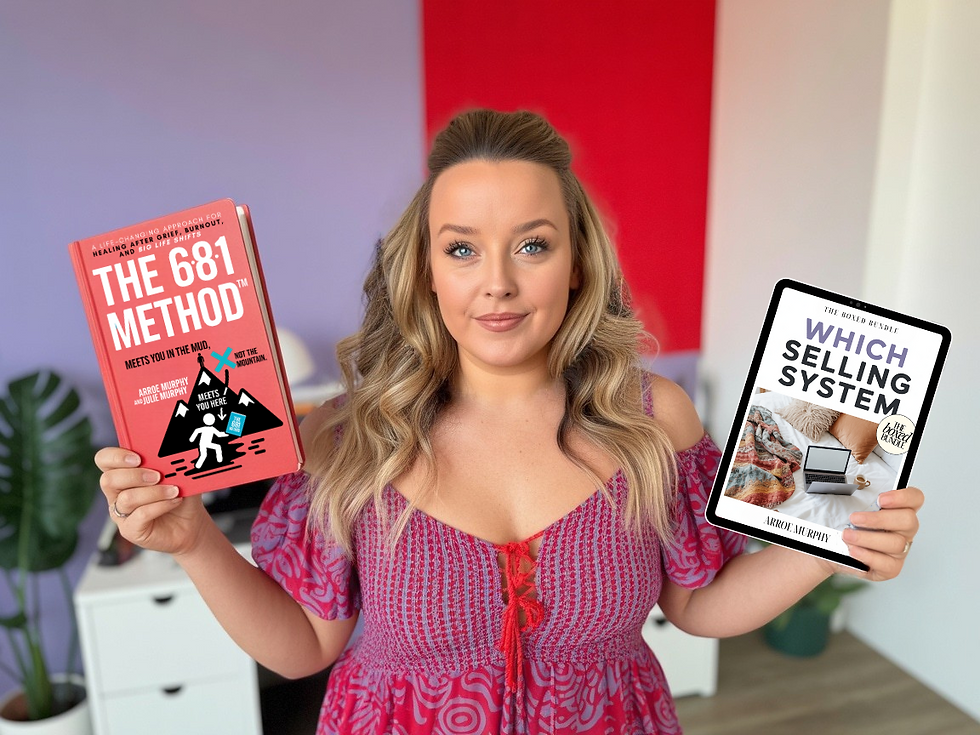
This chapter — The Years That Took Everything — is part of my book, The 6:8:1 Method.
The book isn’t traditional self-help. It’s not about quick fixes or empty positivity. It’s part memoir and part toolkit. The real, grounded methods I built in those years to survive, to manage, and to slowly build stability again.
I also created a companion journal so you don’t just read it — you work with it. Because healing isn’t linear. It’s reflection, repetition, and action.
A Final Word
If you’re a carer, or grieving, or just trying to survive something that feels too heavy: you’re not alone. Healing after a loss is the hardest thing you'll ever do.
The 6:8:1 Method and its companion journal are available at arroemurphy.com, or on Amazon if that’s easier.
This chapter is personal, but it’s why I wrote the book. It’s my way of saying: here’s the rope I used to keep going, maybe it can help you too.


Comments