
Amazon KDP Without an Email List: What First-Time Authors Get Wrong
- Arroe Murphy

- Mar 9
- 6 min read
Most people publishing their first book on Amazon KDP think the platform will do the heavy lifting. Upload the manuscript, set a price, hit publish — and let the algorithm sort it out. That's the plan. And for about 99% of first-time authors, that's also exactly why the book disappears into the void two weeks later.
Here's what nobody tells you upfront: Amazon is not your marketing department. It's a shop. And shops don't advertise your product unless you're already selling.
That's where an email list comes in. Not instead of publishing — alongside it. If you want to build something that actually grows, The 5-Day Email Growth Engine walks you through exactly how to start — but keep reading, because understanding why changes how you'll approach everything.

So What Actually Happens When You Publish Without a List?
Amazon KDP works on momentum. The more copies you sell in a short window after launch, the more the algorithm notices your book and starts showing it to more people. It's a feedback loop. Early sales trigger visibility. Visibility drives more sales.
The problem is that momentum has to come from somewhere. If you don't have readers waiting — people you can email on launch day and say "hey, it's out, here's the link" — you're relying entirely on strangers stumbling across your listing. That can happen. But it's slow,
unpredictable, and almost impossible to influence.
An email list flips this. Even a small one. 200 people who actually wanted your book is worth more to your Amazon ranking than 10,000 passive social media followers who might scroll past your launch post without clicking.
The authors who consistently rank — and keep ranking — treat email as infrastructure. Not an optional extra. Not something to figure out "once the book is doing well." Something they built before, during, and after the writing process.
"But I Don't Have an Audience Yet"
This is the most common thing first-time authors say. And I get it — I said the same thing. The idea of building an email list when you've got nothing to offer feels backwards. Like you're setting up a shop with empty shelves.
But here's where that thinking breaks down: you don't need an audience to start building a list. You need a reason for someone to hand over their email address. That's it. A short PDF, a checklist, a sample chapter, a resource guide — something small and genuinely useful that solves one specific problem for the exact reader your book is for.
And then you need a way to get that thing in front of people. Which is where most beginners freeze, because they assume it requires thousands of followers or a podcast or years of blogging.
It doesn't. The fastest way I've seen this work — and one I've used myself — is paid ads. Small ones. Specifically, Facebook and Instagram ads running on as little as $5 a day, targeted at exactly the type of reader your book is written for. Done right, that kind of campaign can bring in 100+ new email subscribers a week. At roughly £25 a week, that's a list growing by 400 people a month while you're still writing your second chapter.
That's the model behind The 5-Day Email Growth Engine — it's built around this exact approach for authors who are starting from zero and don't want to wait years for organic growth to kick in.
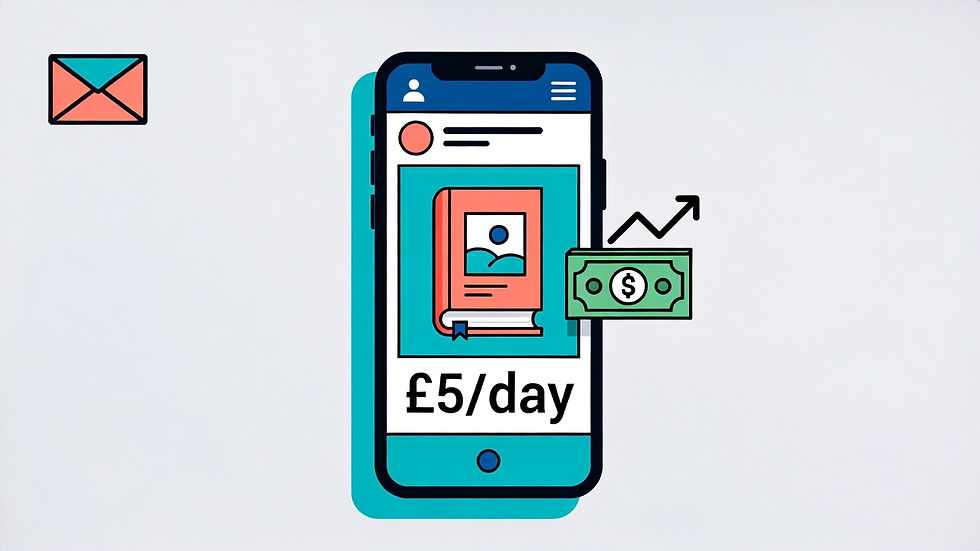
The $5/Day Method: Why Paid Ads Work for New Authors
I know what you're thinking. Ads sound expensive. And complicated. And like something you need a marketing degree to pull off without burning money.
That's a fair concern — and it's also the most common misconception I hear from KDP beginners. Most people assume paid ads are for established businesses with fat budgets and dedicated ad teams. The reality is that a well-targeted $5/day campaign can outperform a £500 boosted post that's aimed at the wrong people.
The key word is targeted. If you're writing a cozy mystery series set in the Scottish Highlands, your reader is a specific person. They read certain authors. They follow certain pages. Facebook's ad platform lets you put your lead magnet — your freebie — directly in front of that person for pennies per click.
According to a 2023 report by the Alliance of Independent Authors, email remains the highest-converting channel for indie book launches, outperforming social media by a significant margin in direct sales. That's not surprising when you think about it. Email is personal. Someone who signed up to hear from you is actively choosing to be in your world.
The maths here isn't hard. If $5 a day gets you 15 new subscribers, you'll have 450 people on your list in a month. By the time your book launches — assuming you started building 3 months out — you've got 1,350 warm readers who already know your name, already downloaded your freebie, and already decided they like what you're doing. That's a launch. Not a lottery.
What to Put in Your Emails Before the Book Is Even Out
This is the question most lists never answer. People understand they need subscribers — but then they have no idea what to actually send them.
Here's a simple way to think about it: your pre-launch emails aren't marketing. They're updates from someone doing interesting work. Behind-the-scenes progress. Cover reveal. Chapter title decisions. The bit of research that sent you down a rabbit hole for three days. The reason you're writing this book at all.
Readers who sign up months before your book launches aren't looking for a sales funnel. They're interested in you. In the work. Which means even a very basic email — "I finished the first draft today, here's what surprised me about it" — builds more trust than a polished newsletter nobody asked for.
By the time launch day comes, emailing that list to say "it's live on KDP, here's the link" doesn't feel like selling. It feels like an update. And they buy because they've been along for the ride.
[Internal link: article on how to write a pre-launch email sequence for KDP authors]

The Misconception That Kills Most Self-Publishing Plans
Here's something worth saying plainly: most first-time KDP authors believe that writing a good book is enough. That quality will find its audience eventually.
It won't. Not on its own. Not without a mechanism for getting it in front of people.
This isn't cynical — it's just how a marketplace with over 4 million titles works. Your book could genuinely be the best thing in its category and still not sell if nobody knows it exists. Amazon's own internal data, referenced in their KDP Select documentation, confirms that books with verified purchase velocity in their first 30 days rank significantly higher in category searches than those with flat sales curves.
Velocity means early sales. Early sales require people who were already waiting. And people who were already waiting came from somewhere — usually an email list.
The authors who crack this aren't necessarily better writers. They're better at treating publishing as a process, not an event. Building while writing. Marketing while editing. Growing while finishing.
[External link: Alliance of Independent Authors — selfpublishingadvice.org]
Start Before You're Ready
Publishing your first book without an email list isn't a fatal mistake. Plenty of authors have done it and eventually found their footing. But it's the long road. And it doesn't have to be.
You don't need to wait until the book is done. You don't need 10,000 followers. You don't even need a big budget — which, now that I think about it, is probably the thing that holds most new authors back more than anything else. The assumption that list-building is expensive.

Start with a small daily ad spend. Build a simple lead magnet. Direct people to a sign-up page. Email them occasionally about what you're working on. Do this for three to six months before you launch, and you'll have something most self-published authors never build: a room full of people who actually want to read your book.
If you want a step-by-step framework for doing exactly that — growing a real email list on $5 a day, starting from zero — The 5-Day Email Growth Engine is where I'd point you next. It covers the ad setup, the lead magnet strategy, and the email sequence that turns subscribers into launch-day buyers.
Build the list while you write the book. By launch day, you won't be hoping someone finds you. You'll already have readers waiting.


Comments